
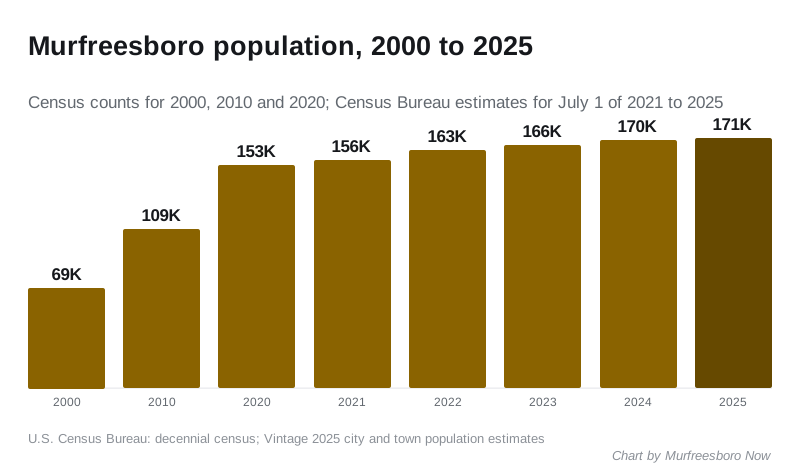
Murfreesboro had an estimated 171,178 people on July 1, 2025, up 12% since the 2020 census and 57% since 2010. Tennessee's sixth-largest city.
Last checked Oct. 19, 2026. Figures come from the U.S. Census Bureau: the 2000, 2010 and 2020 censuses, the Vintage 2025 population estimates for cities and towns (released in May 2026) and the 2020-2024 American Community Survey five-year estimates. See also the Census Bureau’s QuickFacts for Murfreesboro.
Murfreesboro had an estimated 171,178 residents on July 1, 2025, according to the Census Bureau. That is up 12% from the 152,769 counted in the 2020 census and 57% from the 108,755 counted in 2010. In 2000, the city had 68,816 people; it has more than doubled since. It is Tennessee’s sixth-largest city, after Nashville, Memphis, Knoxville, Chattanooga and Clarksville.
Who to call
- City of Murfreesboro Planning Department (local growth plans): 615-893-6441
- City population and development dashboards: Development Services
How the city has grown
| Year | Population | Source |
|---|---|---|
| 2000 | 68,816 | Census |
| 2010 | 108,755 | Census |
| 2020 | 152,769 | Census |
| 2021 | 156,433 | Estimate |
| 2022 | 162,722 | Estimate |
| 2023 | 166,381 | Estimate |
| 2024 | 169,752 | Estimate |
| 2025 | 171,178 | Estimate |
The estimates show growth slowing: the city added about 6,300 people from 2021 to 2022, but about 1,400 from 2024 to 2025.
Who lives here
From the Census Bureau’s 2020-2024 American Community Survey:
- Median age: 31.6 years. About 23% of residents are under 18, and 10.6% are 65 or older. Nearly 12% are 20 to 24; Middle Tennessee State University’s main campus is in the city.
- Households: 60,683, averaging 2.59 people. There are 66,400 housing units.
- Owners and renters: 52.4% of occupied homes are owner-occupied.
- Income: median household income of $80,108.
- Education: 43% of adults 25 and older hold a bachelor’s degree or higher.
- Poverty: 8.8% of residents live below the poverty line.
- Home values: the median owner-occupied home is valued at $402,100; median gross rent is $1,481 a month.
Compared with the county and neighbors
| Murfreesboro | Smyrna | La Vergne | Rutherford County | Tennessee | |
|---|---|---|---|---|---|
| 2025 estimate | 171,178 | 63,321 | 42,146 | 386,352 | n/a |
| Growth since 2020 census | +12.1% | +19.3% | +8.9% | +13.1% | n/a |
| Median age | 31.6 | 34.1 | 33.6 | 34.2 | 38.9 |
| Median household income | $80,108 | $81,926 | $81,313 | $85,470 | $69,595 |
| Bachelor’s degree or higher | 43.0% | 27.8% | 23.7% | 35.8% | 31.1% |
| Owner-occupied homes | 52.4% | 57.4% | 74.0% | 64.8% | 66.9% |
Growth and population rows come from the 2020 census and the Vintage 2025 estimates; the rest come from the 2020-2024 American Community Survey. Smyrna is about 10 miles away and La Vergne about 14 miles. Murfreesboro holds about 44% of Rutherford County’s people.
What the numbers mean
- Estimates are not counts. The yearly figures are Census Bureau models built from births, deaths and migration; the next full count is the 2030 census.
- The survey figures are five-year averages collected from 2020 to 2024, with margins of error.
More guides: home prices, schools and moving to Murfreesboro.
Frequently asked questions
What is the population of Murfreesboro, Tennessee?
The Census Bureau estimates 171,178 people lived in Murfreesboro on July 1, 2025. The 2020 census counted 152,769.
How fast is Murfreesboro growing?
The city grew about 12% from the 2020 census to mid-2025, adding roughly 18,400 people. It grew 40% between the 2010 and 2020 censuses.
Is Murfreesboro bigger than Franklin?
Yes. Murfreesboro’s 2025 estimate of 171,178 is almost twice Franklin’s 90,226. Murfreesboro ranks sixth among Tennessee cities, behind Nashville, Memphis, Knoxville, Chattanooga and Clarksville.
What is the median age in Murfreesboro?
31.6 years, according to the Census Bureau’s 2020-2024 American Community Survey. That is younger than Rutherford County (34.2) and Tennessee (38.9).
Have your say